How do Germans understand advertising slogans, and what is the effect of slogans that no one understands? Endmark has investigated this in five studies to date. The result: misunderstanding does not equal dislike.
Advertising slogans put to the test
As a naming agency based in Cologne, we develop not only brand names but also slogans, the lines that accompany a brand over the long term. That is why we wanted to know how slogans land with the people they are written for. In five studies between 2003 and 2015, we have examined how German consumers understand advertising slogans – and how slogans work when they are not understood.
“Come in and find out” (or not)
For our first study in 2003, we asked people about the slogans of twelve well-known brands. The result was sobering: many English slogans did not come across the way their senders intended. Only around a third of respondents correctly understood Douglas’s slogan “Come in and find out”; many read it as “come in and find your way back out”. Eight of the twelve companies subsequently switched to a German slogan.

The follow-up studies confirmed the picture. In 2006, we surveyed more than 1,000 people aged 14 to 49 in Hamburg, Munich, Cologne and Leipzig; the next wave followed in 2009. In 2013, we looked at car brand slogans. Comprehension: still lacking. Not one of the 1,000 respondents understood Mitsubishi’s “Drive@earth”.
German slogans don’t fare much better
For our most recent study in 2015, we teamed up with YouGov to ask more than 1,200 people about 20 slogans from beauty, food, fashion, automotive and B2B. For the first time, German slogans were included.
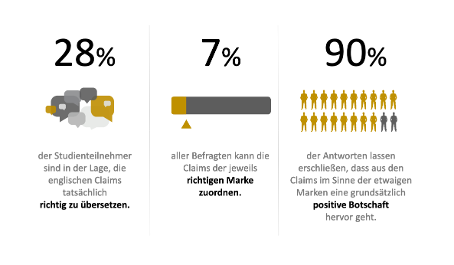
- Only 28% can translate English slogans the way the brand intends.
- 48% understand German slogans “exactly” or “roughly”. Still less than you might expect.
- Not even one slogan in ten is attributed to the right brand: 9% for German slogans, 6% for English ones.
- Younger people do not understand English slogans any better than older people.
It’s not what you say, it’s how you say it
Even so, 90% of responses show that the slogans convey a fundamentally positive message, whether understood or not. Only 16% correctly translated “Beauty with an edge” (Urban Decay), just 1% could match it to the brand – and yet 88% responded positively.
“A slogan is only as good as the verbal world of the brand behind it.” – Christine Stark, Managing Director of Endmark
So a slogan never works on its own, but in interplay with a brand’s name, tone of voice and imagery. If it fits into this verbal world, it conveys an attitude, even if not every word is understood. Shaping this verbal world deliberately is the job of a brand voice.
Do the slogan study findings still apply today?
The latest figures date from 2015. The fundamental question has not changed since: whether a slogan is understood cannot be taken for granted – it can only be tested. That applies to English and German slogans alike.
What makes a good slogan?
From our slogan studies and our daily work on names and brand language, we draw six conclusions:
- Comprehension is not a given, not even in German. Slogans should be tested with the target audience before launch.
- Impact doesn’t depend on every word: a good slogan can land well even if it isn’t understood literally – provided it strikes the right tone for its brand.
- Wordplay is a deliberate choice: it sparks more interest than plain slogans but is misunderstood more often.
- Brand attribution takes time: it depends above all on how long and how intensively a brand advertises.
- Misattributed slogans advertise the competition: if consumers think a slogan belongs to a competitor, it benefits the wrong brand, however good it is.
- A slogan is part of the brand language: it should be developed together with the brand name and tone of voice, not as an afterthought.
These insights still shape our development process for slogans and taglines today.
Curious how your slogan comes across? Get in touch – and find out.
Vom einzelnen Naming bis zum sprachlichen System.
Jetzt unverbindlich beraten lassen!